Linked Lists
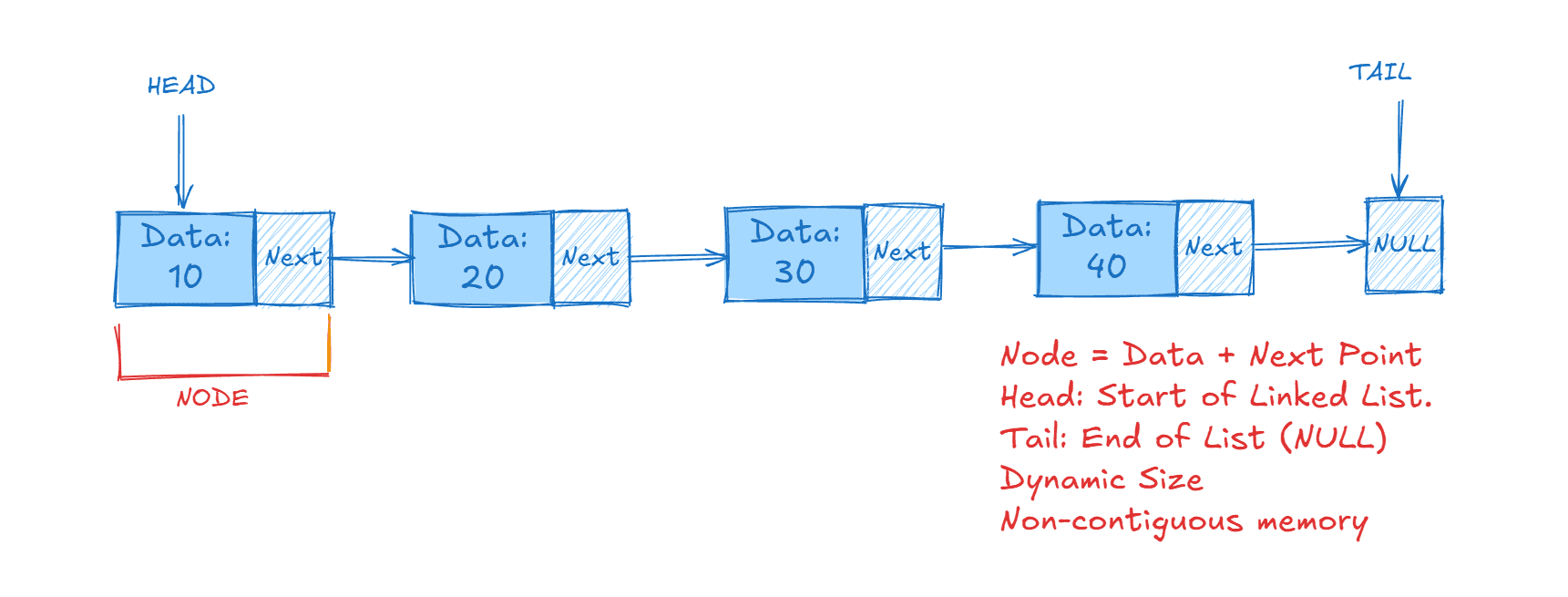
What is a Linked List?
A linked list is a collection of nodes, where each node contains data and a reference (pointer) to the next node.
Why Use a Linked List?
The primary reason to use a linked list over a static array is for its dynamic size.
- If the size of the data structure is not known during runtime
- If the size will be decided during runtime
- If you need a variable-size data structure
Linked List Structure
A linked list is composed of nodes. The structure of a single node generally looks like this in code (Java example):
// Node structure
class Node {
    int value; // The data part of the node
    Node next; // The pointer/reference to the next node

    // Constructor
    Node(int value) {
        this.value = value;
    }
}
The LinkedList class itself typically maintains three private fields:
private Node head;(The first node)private Node tail;(The last node)private int length;(The number of nodes)
Time Complexity Comparison (Linked List vs. Array)
The following table compares the typical time complexities for common operations in Linked Lists and Arrays:
| Operation | Linked List | Array |
|---|---|---|
| Append | O(1) | O(1) |
| Remove Last | O(n) | O(1) |
| Prepend | O(1) | O(n) |
| Remove First | O(1) | O(n) |
| Insert | O(n) | O(n) |
| Remove | O(n) | O(n) |
| Searching | O(n) | O(n) |
Key Methods
Append Method
The append method adds a new node to the end of the list.
public void append(int val) {
    Node newNode = new Node(val);
    if (length == 0) { // Case 1: List is empty
        head = newNode;
        tail = newNode;
    } else { // Case 2: List is not empty
        tail.next = newNode;
        tail = newNode;
    }
    length++;
}
Implementation Notes:
- If the list is empty (
length == 0), the new node becomes both the head and the tail - Otherwise, the current tail's
nextpointer is set to the new node, and thetailis updated to point to the new node
Remove Last Method
The removeLast method removes the last node from the list.
public Node removeLast() {
    if (length == 0) return null; // Case 1: List is empty

    Node temp = head;
    Node pre = head;

    while (temp.next != null) { // Traverse until 'temp' is the last node
        pre = temp; // 'pre' tracks the node before 'temp'
        temp = temp.next;
    }

    tail = pre; // The new tail is the node before the old tail
    tail.next = null; // Remove the link to the old tail
    length--;

    if (length == 0) { // Case 2: After removal, the list is now empty
        head = null;
        tail = null;
    }

    return temp; // Return the removed node
}
Prepend Method
The prepend method adds a new node to the beginning of the list.
public void prepend(int val) {
    Node newNode = new Node(val);

    if (length == 0) { // Case 1: List is empty
        head = newNode;
        tail = newNode;
    } else { // Case 2: List is not empty
        newNode.next = head; // New node points to the current head
        head = newNode; // Head is updated to the new node
    }
    length++;
}
Implementation Notes:
- If the list is empty, the new node becomes both the head and the tail
- Otherwise, the new node points to the current head, and the head is updated to the new node
Remove First Method
The removeFirst method removes the node at the beginning of the list.
public Node removeFirst() {
    if (length == 0) return null; // Case 1: List is empty

    Node temp = head; // Reference the current head to return later
    head = head.next; // Head is moved to the next node
    temp.next = null; // Disconnect the old head from the list
    length--;

    if (length == 0) { // Case 2: After removal, the list is now empty
        head = null;
        tail = null;
    }

    return temp;
}
Implementation Notes:
- Store a reference to the current head before moving it
- Move the head pointer to the next node
- Disconnect the old head from the list
- If the list becomes empty after removal, set both head and tail to null
Get Method
The get method retrieves the node at a specific index.
public Node get(int index) {
    // Check for an invalid index
    if (index < 0 || index >= length) {
        return null;
    }

    Node temp = head;
    // Loop iterates up to the index
    for (int i = 0; i < index; i++) {
        temp = temp.next;
    }
    return temp;
}
Implementation Notes:
- First validate that the index is within valid bounds (0 to length-1)
- Traverse the list from the head, moving forward until reaching the desired index
- Return the node at that position
Insert Method
The insert method adds a new node at a specific index.
public boolean insert(int index, int val) {
    // Check for an invalid index
    if (index < 0 || index > length) {
        return false;
    }

    if (index == 0) { // Case 1: Insert at the start
        prepend(val);
        return true;
    }

    if (index == length) { // Case 2: Insert at the end
        append(val);
        return true;
    }

    Node newNode = new Node(val);
    // Get the node *before* the insertion point
    Node prevNode = get(index - 1);

    // Reroute the pointers:
    newNode.next = prevNode.next; // New node points to the node *after* prevNode
    prevNode.next = newNode; // prevNode points to the new node

    length++;
    return true;
}
Implementation Notes:
- Validate the index (can be from 0 to length, inclusive)
- Use existing
prependmethod if inserting at the beginning - Use existing
appendmethod if inserting at the end - For middle insertions, get the node before the insertion point and reroute pointers
Remove Method
The remove method removes a node at a specific index.
public Node remove(int index) {
    // Check for an invalid index
    if (index < 0 || index >= length) {
        return null;
    }

    if (index == 0) { // Case 1: Remove the first node
        return removeFirst();
    }

    if (index == length - 1) { // Case 2: Remove the last node
        return removeLast();
    }

    // Get the node *before* the removal point
    Node prev = get(index - 1);
    Node temp = prev.next; // The node to be removed

    // Reroute the pointers:
    prev.next = temp.next; // prev node skips over temp, pointing to the node *after* temp
    temp.next = null; // Disconnect the removed node from the list

    length--;
    return temp;
}
Implementation Notes:
- Validate the index is within bounds (0 to length-1)
- Use existing
removeFirstmethod if removing the first node - Use existing
removeLastmethod if removing the last node - For middle removals, get the node before the removal point and reroute pointers to skip over the removed node
Types of Linked Lists
-
Singly Linked List
- This is the most basic form, where each node has a pointer to the next one, allowing traversal in only one direction.
-
Doubly Linked List
- In a doubly linked list, each node has an additional pointer,
prev, which points to the previous node. This allows for bidirectional traversal, but it uses more memory per node.
- In a doubly linked list, each node has an additional pointer,
-
Circular Linked List
- A circular linked list is one where the last node's
nextpointer points back to the head of the list, creating a loop. This can be either singly or doubly linked.
- A circular linked list is one where the last node's
LeetCode Problems for Linked Lists
| Problem Title | Difficulty | Concept / Pattern |
|---|---|---|
| Reverse Linked List | Easy | Iterative / Recursive Linked List Reversal |
| Merge Two Sorted Lists | Easy | Two-Pointer Merge Technique |
| Linked List Cycle | Easy | Cycle Detection (Floyd’s Tortoise and Hare) |
| Remove Nth Node From End of List | Medium | Two-Pointer Technique (Fast & Slow Pointers) |
| Add Two Numbers | Medium | Linked List Traversal with Carry Propagation |
| Odd Even Linked List | Medium | Linked List Reordering by Index Parity |