Mathematics for DSA
Understanding the mathematical foundations is crucial for mastering Data Structures and Algorithms (DSA). This section covers key concepts that will help you analyze and design efficient algorithms.
Why Mathematics Matters in DSA
- To analyze the time and space complexity of algorithms
- To understand problem constraints and optimize solutions
- To use mathematical reasoning for algorithm design and proofs
Complexity Theory
Understanding Big O, Big Θ, and Big Ω notations to describe algorithm efficiency.
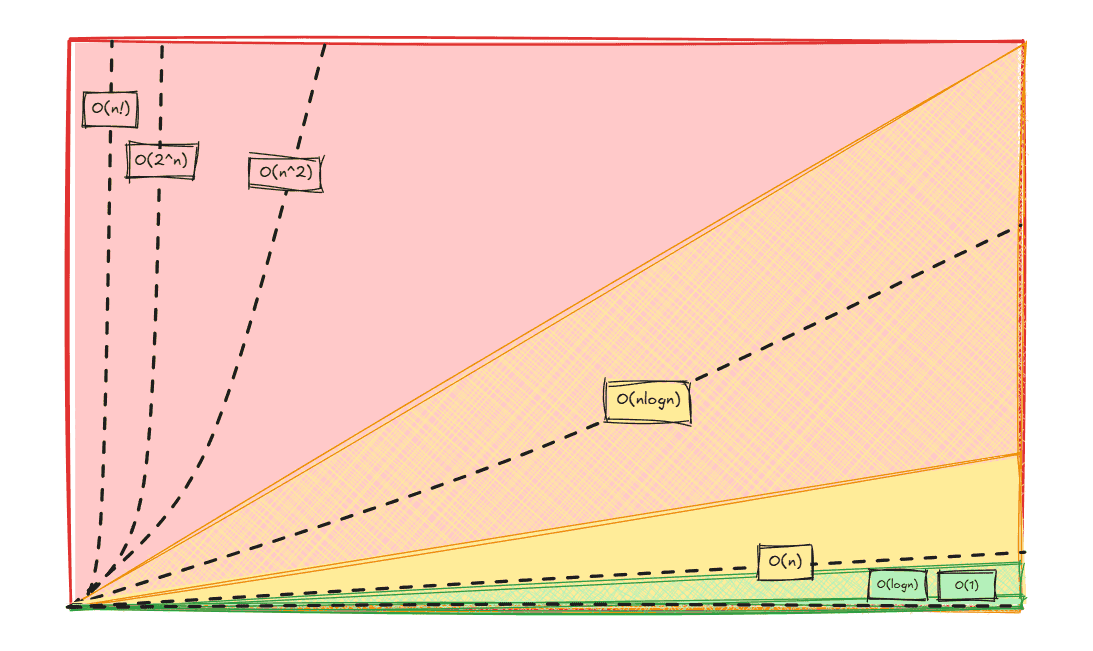
Big-O Notation (O-notation):
-
Describes the upper bound of algorithm performance
-
Represents worst-case time complexity
Big-Omega Notation (Ω-notation):
-
Describes the lower bound of algorithm performance
-
Represents best-case time complexity
Big-Theta Notation (Θ-notation):
-
Describes tight bounds when upper and lower bounds are the same
-
Represents average-case complexity
Important Mathematical Concepts
Number Theory
Number theory forms the foundation of many algorithms and computational problems in computer science. Understanding these concepts helps optimize algorithms and solve complex computational challenges.
Greatest Common Divisor (GCD)
GCD is the largest positive integer that divides two or more numbers without leaving a remainder. The Least Common Multiple (LCM) is the smallest positive integer that is divisible by both numbers.
Key Relationship: For any two numbers a and b: a × b = GCD(a, b) × LCM(a, b)
Methods to find GCD:
-
Euclidean Algorithm: This is the most efficient method. It is based on the principle that the GCD of two numbers does not change if the larger number is replaced by its difference with the smaller number. This process continues until one of the numbers becomes zero, and the other number is the GCD.
// Function to calculate the Greatest Common Divisor (GCD) of two numbers
function gcd(a, b) {
  // Repeat the process until the remainder becomes 0
  while (b !== 0) {
    let temp = b; // Store the current value of b in a temporary variable
    b = a % b; // Update b to the remainder of a divided by b
    a = temp; // Update a to the previous value of b (stored in temp)
  }
  return a; // When b becomes 0, 'a' contains the GCD
}
Least Common Multiple (LCM)
LCM of two integers is the smallest positive integer that is divisible by both numbers. It can be calculated using the relationship between GCD and LCM:
function lcm(a, b) {
  return (a * b) / gcd(a, b); // LCM is calculated using the formula: (a * b) / GCD(a, b)
}
Combinatorics
Combinatorics deals with counting, arranging, and selecting objects from sets. Crucial for analyzing algorithm complexity and solving optimization problems.
Fundamental Counting Principles
-
Multiplication Principle (Product Rule): If event A can occur in m ways and event B in n ways independently, total = m × n.
-
Addition Principle (Sum Rule): If event A can occur in m ways and event B in n ways (mutually exclusive), total = m + n.
-
Example: Choosing a dessert from 3 cakes or 2 ice creams = 3 + 2 = 5 ways.
Permutations
- Arrangements of objects where order matters.
- Formula:
P(n, r) = n! / (n - r)! - Example: Arranging 3 books (A, B, C) on a shelf = 3! = 6 ways (ABC, ACB, BAC, BCA, CAB, CBA).
Combinations
- Selections of objects where order does not matter.
- Formula:
C(n, r) = n! / (r! (n - r)!) - Example: Choosing 2 fruits from (Apple, Banana, Cherry) = C(3, 2) = 3 ways (AB, AC, BC).
Recurrence Relations & Series
Recurrence relations express sequences where each term depends on previous terms. Essential for recursive algorithm analysis.
Common Recurrence Relations:
- Fibonacci Sequence:
F(n) = F(n-1) + F(n-2)with base casesF(0) = 0,F(1) = 1 - Factorial:
n! = n × (n-1)!with base case0! = 1 - Geometric Series: Sum of a series where each term is a constant multiple of the previous term. Formula:
S = a(1 - r^n) / (1 - r)forr ≠ 1, whereais the first term,ris the common ratio, andnis the number of terms. - Arithmetic Series: Sum of a series where each term increases by a constant difference. Formula:
S = n/2 * (a + l), wherenis the number of terms,ais the first term, andlis the last term.
Solving Recurrence Relations:
- Substitution Method: Guess the form of the solution and use mathematical induction to prove
- Recursion Tree Method: Visualize the recurrence as a tree and sum the costs at each level
- Master Theorem: Provides a direct way to solve recurrences of the form
T(n) = aT(n/b) + f(n), wherea ≥ 1andb > 1
Probability and Statistics
- Analyzing randomized algorithms
- Understanding expected values, conditional probability, independence