Stack
Introduction to Stacks
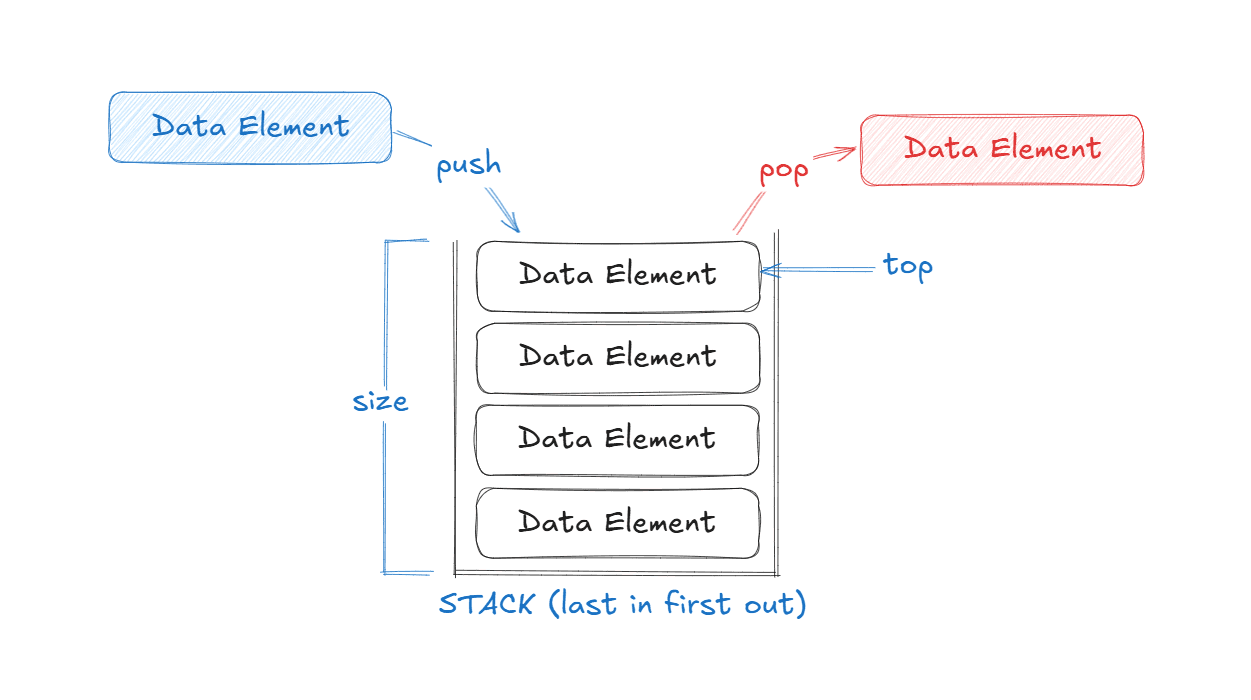
A stack is a fundamental linear data structure that follows a particular order for operations. The order is LIFO (Last-In, First-Out). Think of it like a stack of plates: you can only add a new plate to the top, and you can only take a plate from the top. The last plate you put on is the first one you take off.
This "last-in, first-out" principle makes stacks incredibly useful for managing tasks and data in a specific sequence.
Core Operations
A stack is defined by a few primary operations that allow you to interact with it. All these operations happen at the "top" of the stack.
1. Push
The push operation adds a new element to the top of the stack.
stack.push("A"); // Adds 'A'
stack.push("B"); // Adds 'B' on top of 'A'
2. Pop
The pop operation removes the topmost element from the stack and returns it. Trying to pop from an empty stack results in an error known as a "stack underflow."
stack.pop(); // Removes and returns 'B'
stack.pop(); // Removes and returns 'A'
3. Peek
The peek operation returns the topmost element without removing it from the stack.
stack.peek(); // Returns 'A'
4. Is Empty
The isEmpty operation checks if the stack is empty.
stack.isEmpty(); // Returns true
5. Size
The size operation returns the number of elements in the stack.
stack.size(); // Returns 0
How Stacks are Implemented
Stacks can be implemented using various underlying data structures. The two most common ways are using arrays and linked lists.
Using an Array (or List)
This is the simplest implementation. An array can be used to store the stack elements, and a variable (often called top) can keep track of the index of the last inserted element.
-
Pros: Easy to implement and memory-efficient (no pointers).
-
Cons: Can have a fixed size, leading to a "stack overflow" if you push too many elements. Dynamic arrays can solve this but may have performance costs for resizing.
JavaScript
// A simple array-based stack implementation in JavaScript
class Stack {
  constructor() {
    this.items = [];
  }

  push(element) {
    this.items.push(element);
  }

  pop() {
    if (this.isEmpty()) {
      return "Underflow";
    }
    return this.items.pop();
  }

  peek() {
    return this.items[this.items.length - 1];
  }

  isEmpty() {
    return this.items.length === 0;
  }
}
Using a Linked List
In this approach, each element is a node that contains data and a pointer to the next node. The top of the stack is the head of the linked list.
-
Pros: The stack can grow dynamically, so there's no fixed size limit (besides available memory).
-
Cons: Requires slightly more memory due to the storage of pointers in each node.
Complexity Analysis
The efficiency of stack operations is one of its greatest advantages.
| Operation | Time Complexity | Space Complexity |
|---|---|---|
| Push | O(1) | O(n) |
| Pop | O(1) | O(n) |
| Peek | O(1) | O(n) |
| isEmpty | O(1) | O(n) |
Real-World Applications
You interact with the stack data structure every day without realizing it!
00
Browser History
Clicking the 'back' button in your web browser pops the previous page from a stack of visited URLs.
01
Undo/Redo Functionality
In text editors or image software, each action you take is pushed onto a stack. Clicking 'undo' pops the last action off the stack.
02
Function Call Stack
When you run a program, function calls are managed using a call stack. When a function is called, it's pushed onto the stack. When it returns, it's popped off. This is how your program knows where to return after a function finishes.
03
Expression Evaluation
Stacks are used to convert expressions (like (5 + 6) * 2) from infix to postfix notation and then evaluate them.
Stacks LeetCode Problems
| Problem Title | Difficulty | Concept / Pattern |
|---|---|---|
| Valid Parentheses | Easy | Parentheses Matching, Basic Stack Usage |
| Min Stack | Easy | Augmented Stack (Tracking Min Value) |
| Implement Queue using Stacks | Easy | Two-Stack Implementation |
| Next Greater Element I | Easy | Monotonic Stack (Introduction) |
| Daily Temperatures | Medium | Monotonic Stack (Finding next warmer day) |
| Evaluate Reverse Polish Notation | Medium | Expression Evaluation |
| Simplify Path | Medium | Path Manipulation, Simulation |
| Decode String | Medium | State Management with Multiple Stacks |
| Largest Rectangle in Histogram | Hard | Monotonic Stack (Advanced Application) |
| Basic Calculator | Hard | Expression Evaluation with Parentheses |