Queues
Introduction to Queues
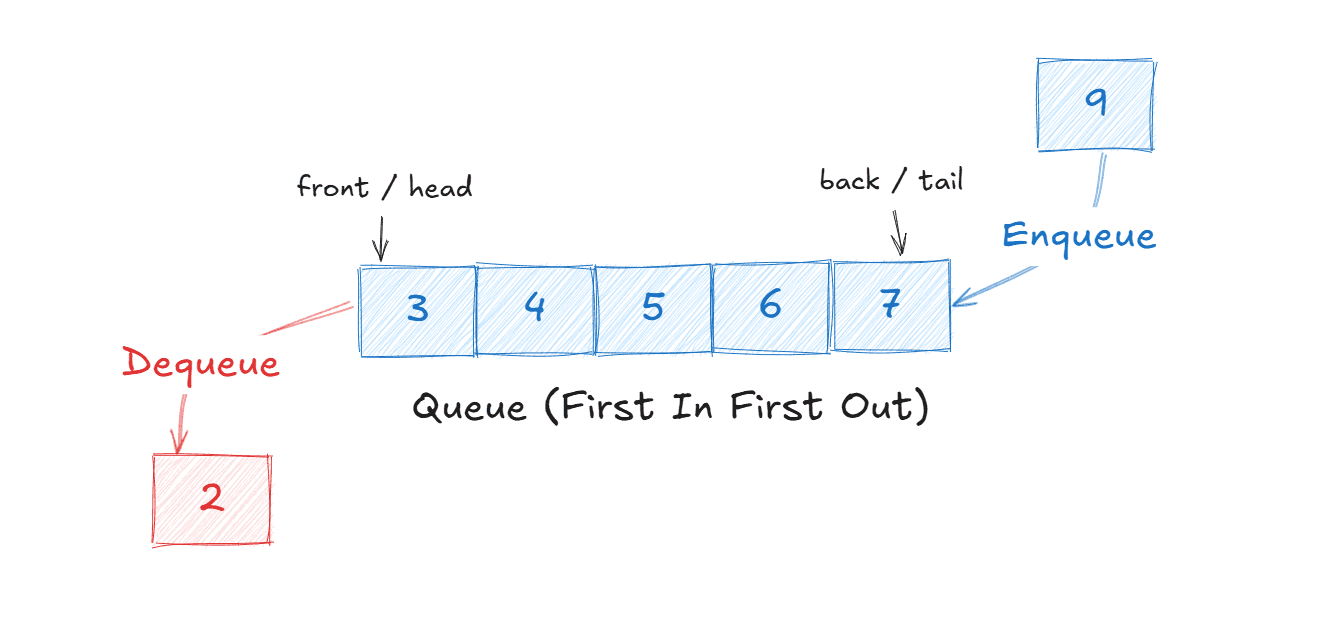
A queue is a linear data structure based on the First-In-First-Out (FIFO) principle, meaning the first element added is the first to be removed. Queues have broad applications in computer programming, operating systems, and networking due to their systematic way of managing sequential data.
Structure and Key Concepts
A queue has two main pointers:
- Front (Head): The position from which elements are removed.
- Rear (Tail/Back): The position where new elements are inserted.
Elements are enqueued (added) at the rear and dequeued (removed) from the front. Unlike arrays or linked lists, direct access to elements in between is not allowed—operations only happen at the ends.
Basic Operations
- Enqueue:
- Add an element at the rear.
- Before insertion, a check is made to see if the queue is full (in static implementation).
- Dequeue:
- Remove and return the element at the front.
- If the queue is empty, an underflow occurs.
- Peek/Front:
- Get the front element without removing it.
- isEmpty:
- Check whether the queue has no elements.
- isFull:
- In fixed-size queues, check if the queue is at its capacity.
Types of Queues
- Simple (Linear) Queue:
- Follows FIFO strictly; insertion at rear, deletion from the front.
- Circular Queue:
- Rear connects back to the front to utilize storage efficiently, avoiding wasted space when the array is full but has space at the head.
- Priority Queue:
- Elements are ordered by priority; removal happens based on priority rather than strictly FIFO.
- Double-Ended Queue (Deque): Insertion and removal operate at both ends, offering greater flexibility.
Implementation Methods
Queues can be implemented using:
- Arrays: Simple and static, but may suffer from wasted space or overflow issues.
- Linked Lists:
- Dynamic, allowing growth/shrinkage as needed.
- Circular Arrays:
- Improve space utilization in static implementations.
Real-World Applications
- Resource Scheduling:
- Operating systems use queues for task scheduling (like CPU or print jobs).
- Buffer Management:
- Network routers, communication systems, and job queues use queues to ensure smooth data flow.
- Simulation: Useful in event-driven programs and modeling real-world waiting lines.
| Problem Title | Difficulty | Description |
|---|---|---|
| Implement Queue using Stacks | Easy | Design a queue's functionality using only two stacks. |
| Number of Islands | Medium | Count the number of islands in a grid by traversing connected land cells. |
| Walls and Gates | Medium | Fill empty rooms with the distance to the nearest gate. |
| Open the Lock | Medium | Find the minimum number of turns to open a lock from a starting state. |
| Binary Tree Level Order Traversal | Medium | Traverse a binary tree level by level. |
| Sliding Window Maximum | Hard | Find the maximum value in a sliding window of size k. |
| Rotting Oranges | Medium | Find the minimum time for all fresh oranges to rot. |
| Perfect Squares | Medium | Find the least number of perfect square numbers that sum to n. |
| 01 Matrix | Medium | Find the distance of the nearest 0 for each cell in a matrix. |
| Dota2 Senate | Medium | Predict which party will dominate a game's senate. |